Deep cut
Monday, October 26, 2026
The Fairmount Water Works - the river machine under the Art Museum hill
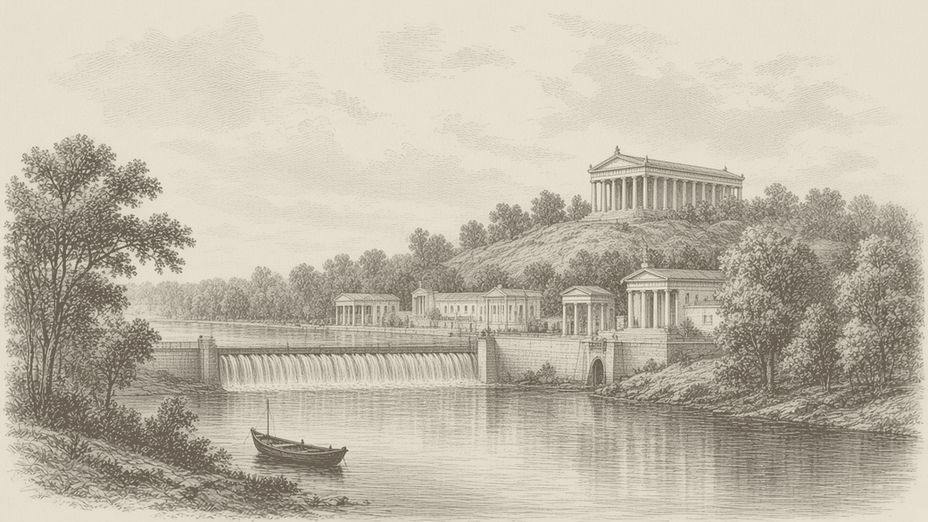
Plenty of people climb the Art Museum steps and never look down at the little white temples by the river at the bottom of the hill. Those buildings are the Fairmount Water Works, and for most of the 1800s they were how Philadelphia got its water.
Plenty of people climb the Art Museum steps and never look down at the little white temples by the river at the bottom of the hill. Those buildings are the Fairmount Water Works, and for most of the 1800s they were how Philadelphia got its water.
The hill the museum sits on was the city's reservoir. The museum came later.
The problem
After the yellow fever epidemics of the 1790s, Philadelphia decided it needed a city water supply, according to the Water Department's own history. The first system pumped Schuylkill water with steam engines at Centre Square, the spot where City Hall stands now.
It didn't hold up. The engines kept breaking down and cost a fortune to run. Within about a dozen years, city officials knew they needed something bigger.
The hill idea
Frederick Graff, the engineer running the waterworks, and John Davis backed a plan to build new works at the foot of a hill called Faire Mount, beside the Schuylkill just outside the city line at the time. Pumps would push river water up into reservoirs on top of the hill. From there, gravity would carry it down through pipes into the city.
The Fairmount works opened in 1815. They still ran on steam, though, and the steam engines were expensive. Burning wood to fire the boilers was the biggest cost.
Let the river do the work
So the city went for water power. Building started in 1819 on a dam across the Schuylkill at Fairmount, and it was finished in 1821. Two histories, the Encyclopedia of Greater Philadelphia and the Water Department's history site, both call it the longest dam in the country when it was built.
Behind the dam, the river ran into a channel blasted out of the rock and down through big water wheels inside a mill house at the river's edge. The wheels drove the pumps. By the fall of 1822 the wheels were running and the steam engines were shut off.
In 1844 the works supplied an average of 5.3 million gallons a day to 28,082 customers, by the count both histories give. Starting in 1851, the wheels gave way to newer turbines, and by the early 1870s turbines did all the pumping.
Why it looks like a temple
Graff dressed up the machinery. He put small buildings shaped like classical temples on the mill house roof and made the whole place pretty enough to visit. Visitors could walk out on the roof, hear the water pouring over the wheels and climb up the hill to look at the reservoirs.
By the 1820s and 1830s the Water Works was one of the city's must-see stops, and painters and printmakers kept coming back to draw it.
How it made Fairmount Park
Here's the part I like best. To keep the water clean, the city started buying up land along the river above the dam. The first pieces were old estates like Lemon Hill, and the biggest purchases came in the late 1860s and early 1870s. The 1867 state law that set up the Fairmount Park Commission said the land was for "the preservation of Schuylkill water and of the health and enjoyment of the people forever."
So the park a lot of us walk and bike in got started as a way to protect the drinking water.
The end of pumping
It didn't work forever. Factories upriver kept fouling the Schuylkill, and typhoid kept coming back. The city moved to filtration plants, and there wasn't room at Fairmount to build one. The Water Works stopped supplying the city in 1909. One manufacturer kept using water pumped there for a couple of years, and the works shut down for good in 1911.
The aquarium years
Then the buildings got a second life. In 1911 most of the pumping machinery came out and the Philadelphia Aquarium moved in, with freshwater fish in the old mill house and seawater exhibits in the newer one. For a while, sea lions and seals swam in the old forebay, the channel that used to feed the wheels. The forebay was later filled in, and the stone bridge over it is still buried under Aquarium Drive.
The aquarium closed in 1962. A swimming pool went into the newer mill house after that and ran until the early 1970s.
Saved
After the pool closed, the buildings sat empty for years and fell apart. In the 1970s the Junior League of Philadelphia started raising money to save them. The site became a National Historic Landmark, and the restoration took decades.
Today the old mill house holds the Water Department's Fairmount Water Works Interpretive Center, which teaches people about the city's rivers and watersheds. The old engine house is a restaurant. The South Garden and the cliffside paths were brought back to how they looked in the 1800s.
Myth check
- "Philadelphia had the first city water system in America." I'm not printing that. The Water Department says Philadelphia was "one of the first" in the U.S. to take on water as a city job. The Encyclopedia goes further. The safe line is that Philly was early.
- "Centre Square opened in 1801." Sources split. The Water Department says city water service started in 1801, and the Encyclopedia dates the Centre Square works to 1799. Both can be right, since building and pumping aren't the same day, so I left the year out.
- "The Water Works closed in 1909." Half right. It stopped supplying the city in 1909 and shut down completely in 1911.
- "The Art Museum is on the reservoir." True. The Water Department, the Encyclopedia and the Water Works' own tour guide all say the museum stands where the reservoir was.
Going now
The Water Works is at 640 Waterworks Drive, just down the hill from the Art Museum, right on the river trail. The Interpretive Center is open Wednesday through Saturday, 10am to 5pm, and admission is free. Saturdays from 1 to 4 there are hands-on activities for all ages. Free two-hour parking runs along Waterworks Drive, and SEPTA's 32 and 38 buses stop nearby. It's a working education center with school groups, so keep it calm on weekday mornings.
Stand on the mill house terrace and look at the dam. Then turn around, look up the hill, and picture a reservoir where the museum is.
The short version
Those temples at the foot of the Art Museum used to pump Philadelphia's water. The Fairmount Water Works opened in 1815, switched to river-powered wheels in 1822, and stopped supplying the city in 1909. After that it was an aquarium for half a century and later a pool. Today it's a free education center you can walk right into.